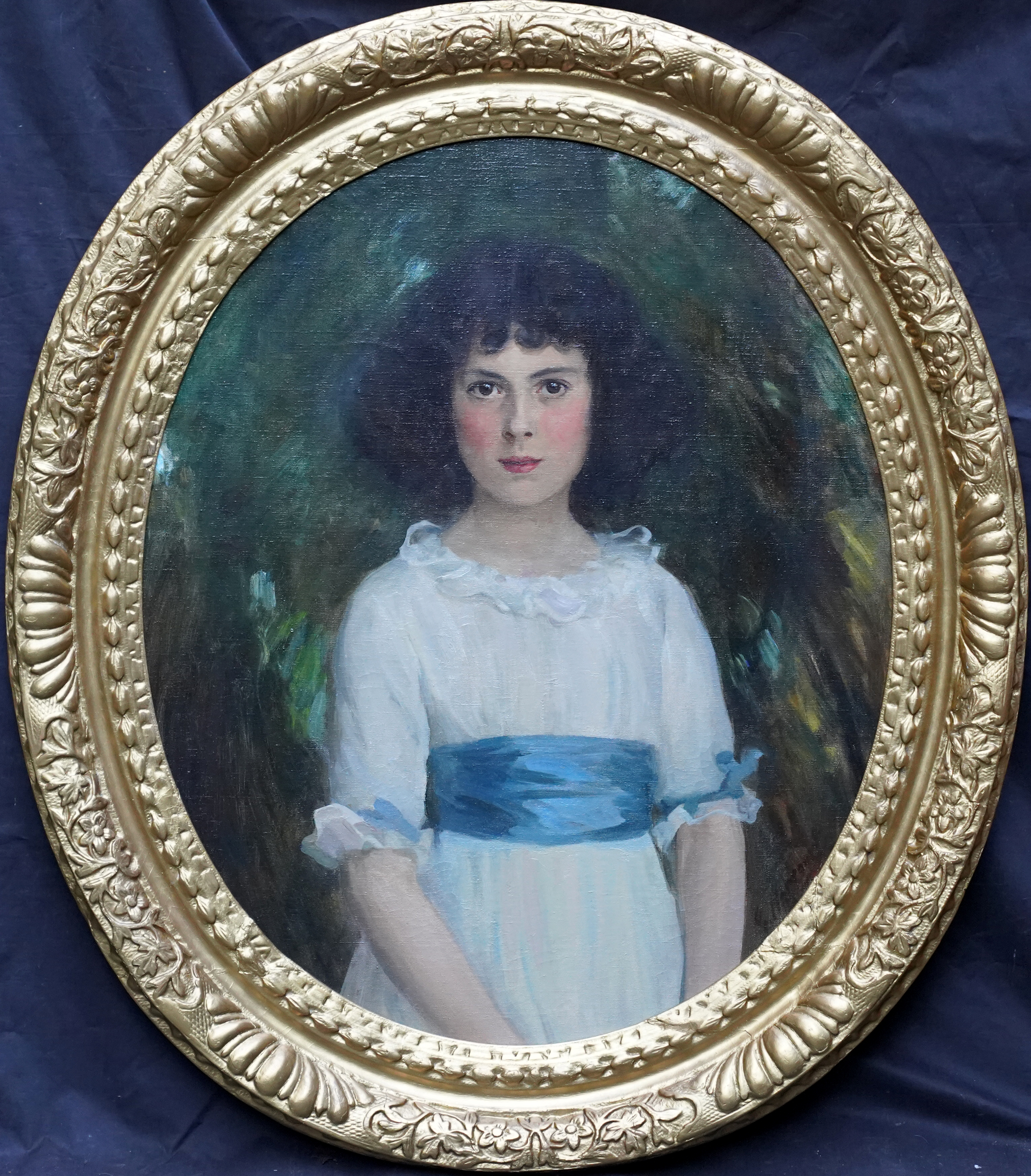
George Harcourt (1869-1947)
| Artist Name | George Harcourt (1869-1947) |
|---|---|
| Title | Portrait of a Girl with Blue Sash and Cuffs |
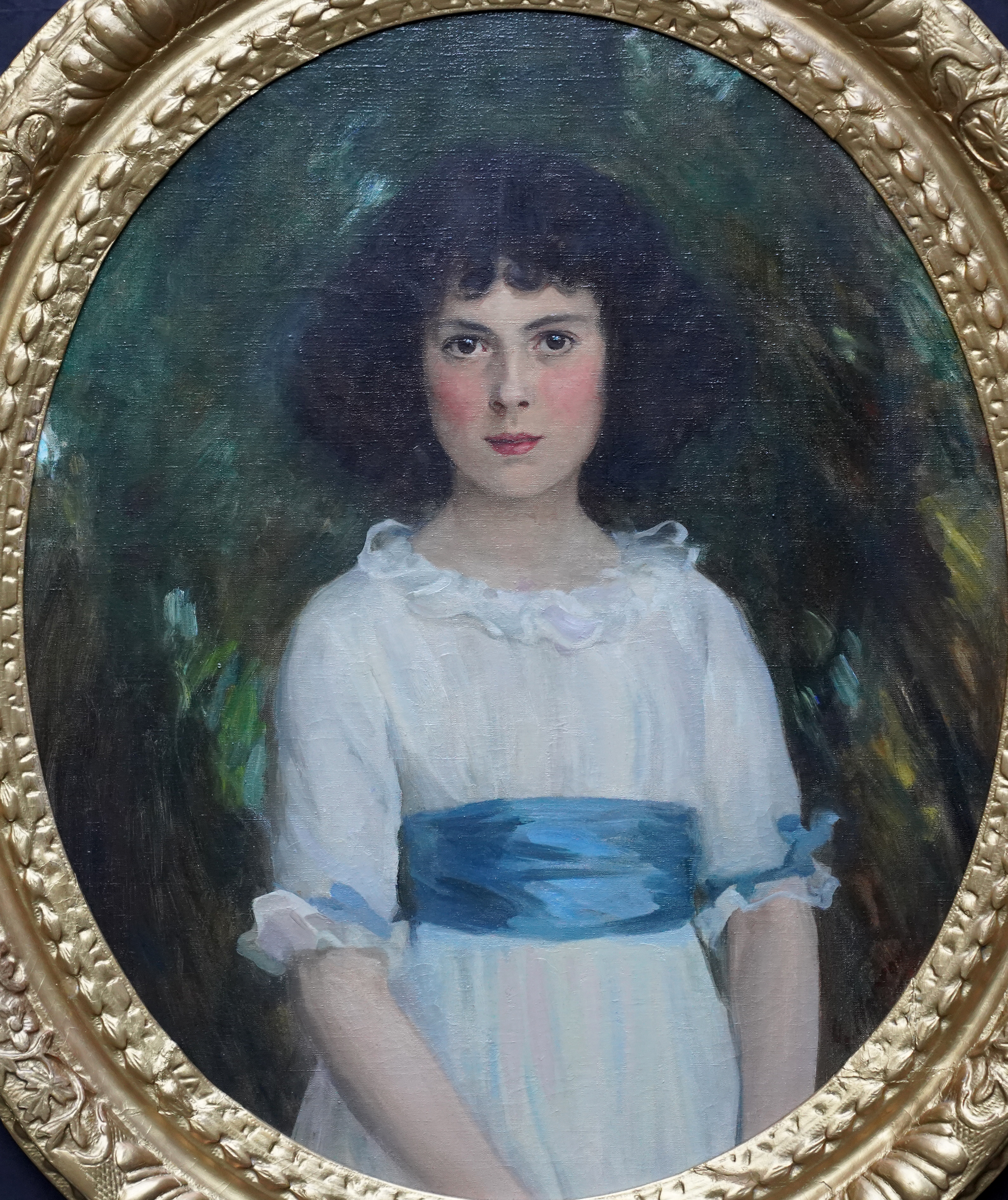
| Description | This lovely Scottish Edwardian oval portrait oil painting is by noted artist George Harcourt. Painted circa 1910 it is a three-quarter length standing portrait of a young girl facing forward with the green of trees behind her. She is wearing a white short sleeved dress with a wide blue sash at the waist and blue ribbon on her cuffs. She has a bob of dark wavy hair and brown eyes gaze at the artist/viewer. (We have a similar portrait of her sister). The brushwork and detail are lovely and the vivid blue of her sash is just gorgeous. This is a charming Scottish Edwardian portrait by a well-respected artist and an excellent example of his work. Signed lower right. |
| Provenance | Berkshire estate. |
| Medium | Oil on Canvas |
| Size | 24 x 30 inches |
| Frame | Housed in an oval gilt frame. Framed size is 37 inches by 31 inches and in good condition. |
| Condition | Good condition. |
| Biography | George Harcourt RA (1868-1947) was a Scottish portrait and figure painter, known for painting influential members of society. Born in Old Kilpatrick in 1868, Harcourt's family moved to nearby Dumbarton while he was still a toddler. In the 1871 census Harcourt's family were living, with two lodgers, in a modest property in the High Street, Dumbarton and Henry Harcourt, George's father worked as a laborer. Harcourt received his initial art training at the Dumbarton School of Art, a satellite of the Glasgow School of Art which operated in Dumbarton at the end of the 19th century. Aged 20 he won the Denny Scholarship which funded further studies abroad. He studied at the Herkomer School of Art in Bushey from 1889–92 and later went on to become the head of school. He rose to become the President of the Royal Society of Portrait Painters in 1945 following a spell as vice-president (1934–45) and was also the Director of the Royal Academy. He first became an associate of the Royal Academy in 1919 (ARA) and was then elected as an Academician (RA) in 1926. In 1944 he was elected as a senior Academician (Senior RA) and became Director of Schools in 1927. After studying art in Dumbarton, Harcourt initially worked as an interior decorator of salons and luxury cabins at the local shipyard Denny Brothers Shipbuilding. In 1888 he went to Bushey, north London, and enrolled in the Herkomer School of Art. The school, founded by the German-born painter Hubert von Herkomer (1849-1914) in 1883, enjoyed a good reputation in England at the time and was known for its unconventional educational practice. As one of the best students, Harcourt later became a lecturer at the art school. Later, he taught at the London Slade School of Fine Art, where his daughter Anne studied. Over the years, Harcourt's style of painting changed from a Pre-Raphaelite influenced naturalism (here mainly genre paintings, more rarely landscapes) to an almost photorealistic portraiture. This perfection not only gave him a reputation among colleagues, but also secured him a good income as a portraitist of the British upper class. He submitted to the Royal Academy of Arts his diploma thesis (A Portrait of Miss Anne Harcourt), this proved he had skills that went beyond the naive kitsch of his earlier years. In 1893 George Moore reviewed the artworks at the Royal Academy commenting in The New Review, London, on a portrait exhibited there by George Harcourt - At the Window. Harcourt died on 30 September 1947. |
| Price | £4500 |