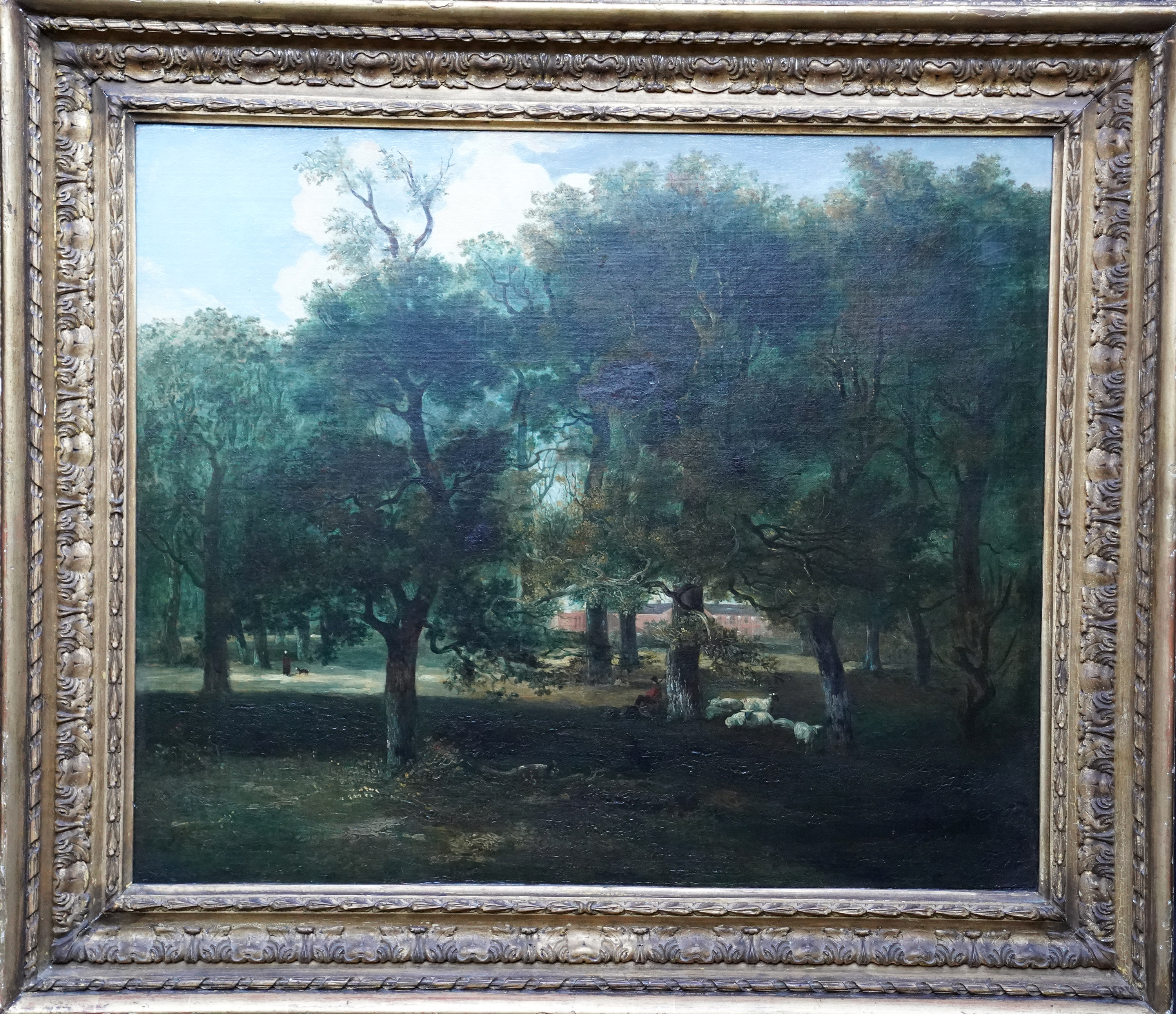
George Vincent (1796-1831)
| Artist Name | George Vincent (1796-1831) |
|---|---|
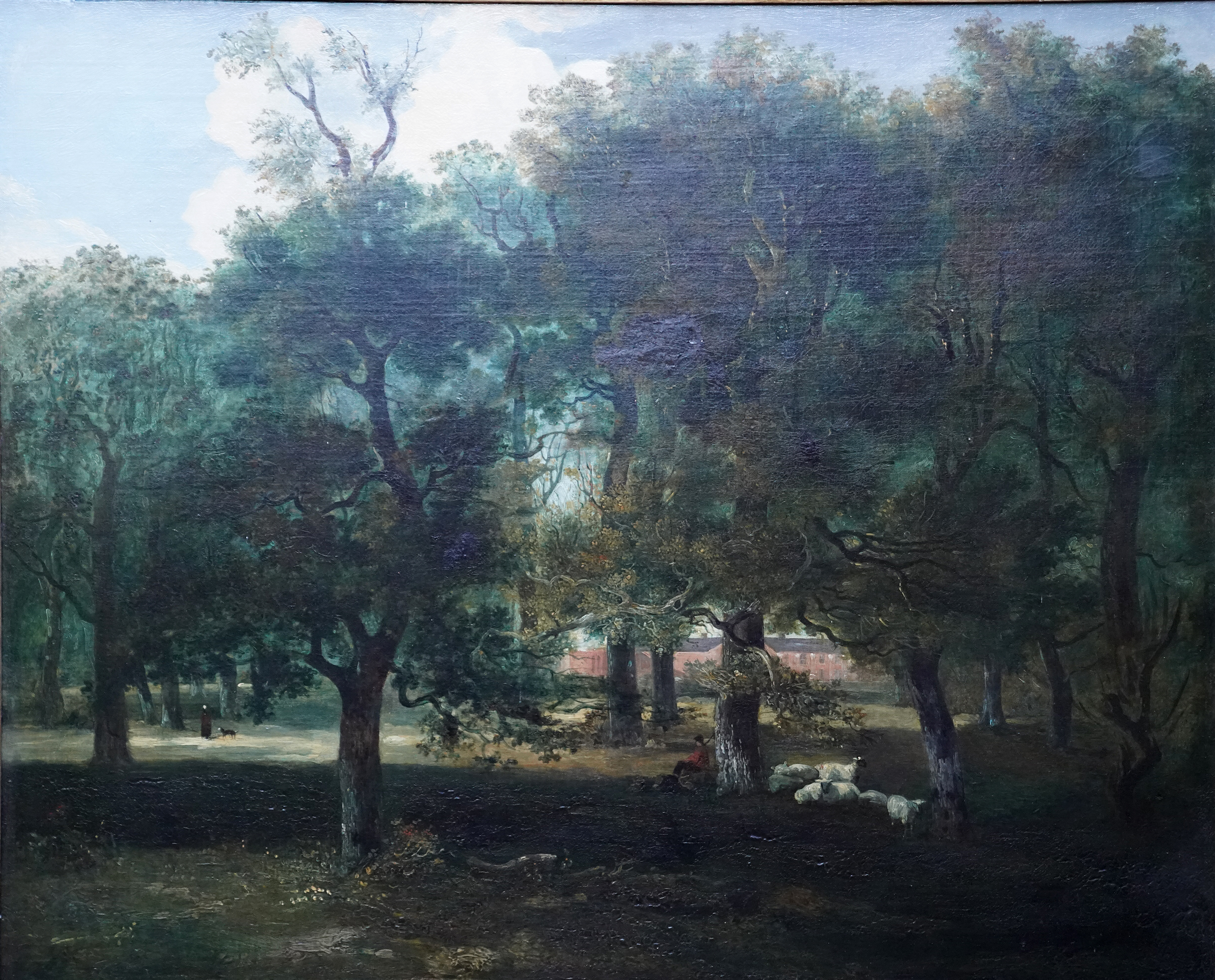
| Title | Woodland Scene with Sheep, Chapelfields, Norwich |
| Description | This lovely British Old Master landscape oil painting with excellent provenance is attributed to being by George Vincent, after John Crome. Painted circa 1820 the setting is a woodland scene with sheep and their shepherd at Chapelfields, Norwich. Beyond the trees is thought to be Stoke Holy Cross Mill. This is a superb British Old Master landscape oil painting with excellent provenance. Unsigned. |
| Provenance | Christie's 26 february 1917 lot 49 as Crome Frost and Reed label verso. Staats Forbes Collection Percy M Turner, Christie's London, 16th March 1934 lot 122 Sir Jeremiah Colman The collection of Surgeon Vice Admiral Godfrey Milton- Thompson John Crome book: plate 89 page 55 Woodland Scene with Sheep 24 1/2 x 29. Details page 207. |
| Medium | Oil on Canvas |
| Size | 29 x 25 inches |
| Frame | Housed in its original ornate gilt carved Maratta frame, 37 inches by 32 inches and in good condition. |
| Condition | Good condition. |
| Biography | George Vincent (1796-1831) was born in Norwich on 27th June, 1796, the son of James Vincent, a cloth manufacturer. After his education at Norwich Grammar School, Vincent became a pupil of John Crome (1768-1821), later known as 'Old Crome', one of the finest English landscape painters who was the founder and inspiration of The Norwich School. Cromes three most important and accomplished students were his son, John BerneyCrome (1794-1842), James Stark (1794-1859) and George Vincent. The three painters were to become close friends, who frequently travelled together and consequently influenced each other's work. In 1816 Vincent visited France with John BerneyCrome and toured Essex with Stark, which resulted in paintings by all three artists. When Vincent first went to London in 1817 he lived in Newman Street, alongside Stark, and they were both admitted as students in the school attached to the British Institution in Pall Mall. In 1819, when Vincent was perhaps at the height of his powers, he toured Scotland, almost certainly in the company of Stark. Following Crome's death in 1821, Vincent married in 1822 and bought himself a good house in Camden Town, partly on the strength of his wife's supposed prosperity. However his income and her wealth must not have lived up to expectations, as by 1824 he had left Camden for a smaller studio and by December of that year his debts had caused him to be incarcerated in the debtor's gallery of the Fleet Prison, from which he was not discharged until February 1827. Vincent was able to paint whilst in prison and continued to do so after his release, exhibiting for the last time in 1831, which is frequently given as the date of his death. However there are records in the British Museum indicating that he inherited part of his father's estate in 1833, so it is likely that died sometime in the mid 1830s. Due to his short life, Vincent's paintings are comparatively rare but it is indicative of the quality of his work that in spite of this he is regarded so highly as an artist and as one of the foremost painters of the Norwich School, which in itself was an important and influential movement in English art. Exhibited : Royal Academy 1814, 1823; British Institution 1815, 1831; Society of British Artists 1824, 1830; Norwich Exhibitions 1811, 1831 Museums : Victoria Albert Museum, London; Castle Museum, Norwich; Nottingham; Sheffield References : East Anglian Painters Volume II, Harold DayPainters of the Norwich School, W. F. Dickes |
| Price | £14000 |